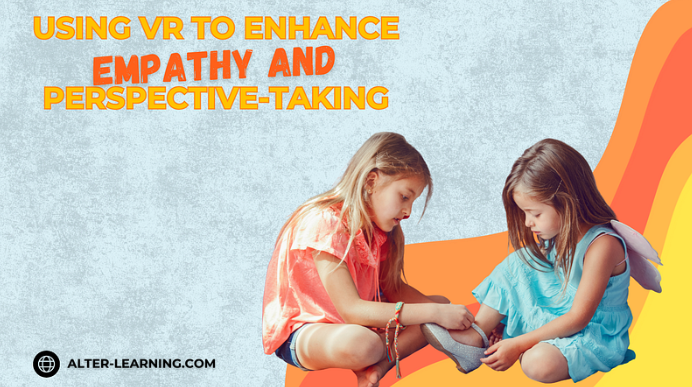
Education is not just about academic knowledge—it is also about building the social and emotional skills that shape who we are. In today’s interconnected world, empathy and perspective-taking are essential for collaboration, conflict resolution, and cultural understanding. But how can schools nurture these skills in meaningful ways?
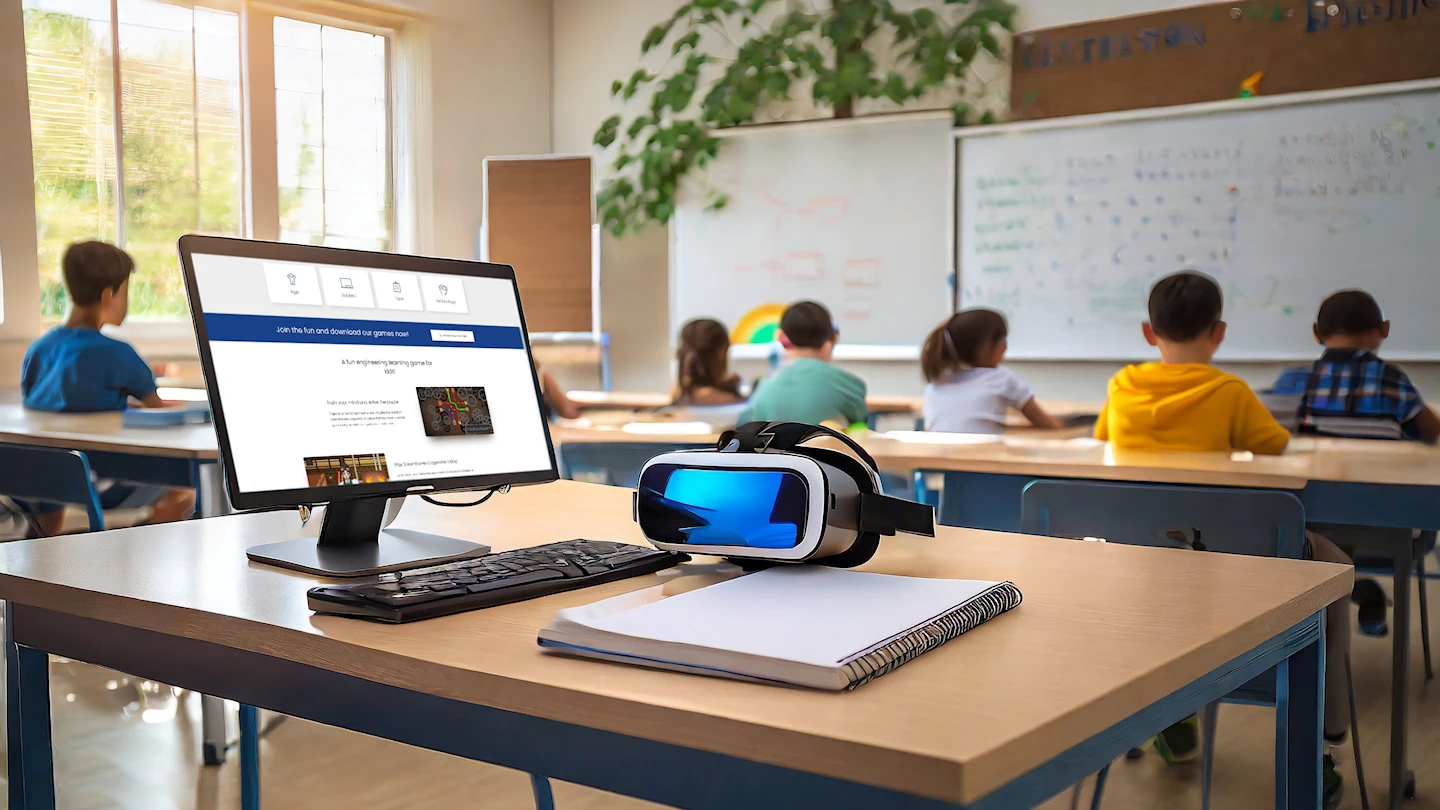
Virtual reality (VR) education apps and immersive learning environments can offer one path forward. By allowing students to step into someone else’s shoes—whether through AR biology exploration, interactive physics simulations, or narrative-driven STEAM educational games—VR can help learners experience perspectives beyond their own. Alter-Learning’s approach demonstrates how immersive technology can support social-emotional growth alongside academic achievement.
The Power of Immersion in Building Empathy
Traditional lessons about empathy often rely on reading stories, role-playing, or class discussions. While valuable, these approaches may not always resonate with every learner. VR, by contrast, can:
- Place students in first-person experiences where they live out different roles,
- Use interactive storylines to show the impact of choices on others,
- Provide realistic, multisensory environments that create emotional connections,
- Encourage reflection by letting students see consequences unfold in real time.
When learners interact with characters, communities, or ecosystems in immersive ways, empathy shifts from being an abstract concept to a felt experience.
Examples of Perspective-Taking in Games
Well-designed educational games can embed empathy-building directly into gameplay. For instance, students may:
- Collaborate in multiplayer environments, supporting one another to achieve shared goals,
- Step into historical or cultural roles to understand the challenges of past societies,
- Explore ecosystem-based simulations that reveal the impact of human actions on nature,
- Engage in wellness-focused activities that highlight emotional regulation and social skills.
These interactive experiences can show learners how decisions ripple outward—encouraging them to consider perspectives beyond their own.
Supporting Social and Emotional Learning (SEL)
Perspective-taking is a key part of Social and Emotional Learning (SEL). VR education apps and XR educational content can complement SEL frameworks by:
- Encouraging self-awareness, as students reflect on how they react in different roles,
- Building social awareness, by exposing learners to diverse narratives and identities,
- Strengthening relationship skills, as students work together in cooperative games,
- Enhancing responsible decision-making, through scenarios that require weighing outcomes.
With VR, these abstract SEL goals can become tangible, engaging, and memorable.
Designing for Empathy, Not Just Entertainment
It’s important to note that not every VR experience automatically builds empathy. To be effective, design choices matter. Developers can focus on:
- Authentic storytelling grounded in real-world issues,
- Balanced challenges that emphasize collaboration over competition,
- Reflection prompts that encourage students to think about what they experienced,
- Inclusive representation, so diverse perspectives are accurately portrayed.
By keeping empathy at the center of design, VR games can be powerful tools for both education and human connection.
Beyond the Classroom: Real-World Impacts
The skills students gain from perspective-taking do not stay in school—they extend to daily life, careers, and communities. Empathy helps future leaders work across cultures, enables engineers to design with users in mind, and supports citizens in making ethical decisions.
Alter-Learning’s focus on immersive STEAM educational games, VR math games, AR science experiments, and digital art creation tools shows how technology can do more than teach content—it can help nurture compassionate, globally minded learners.
When used with intention, VR can be more than just a tool for exploration. It can be a bridge between people, perspectives, and possibilities—helping students not only understand the world but also care for it and those who share it.
Follow Alter-Learning for more insights into immersive education, edtech success stories, and the future of learning. Want to explore how VR/AR could transform your school or learning platform? Let’s connect.