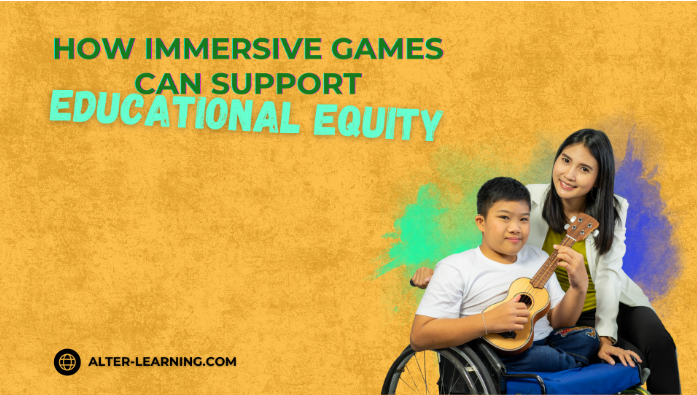
Technology has the power to expand access to education—but only when it’s designed with inclusivity in mind. At Alter-Learning, accessibility is more than a checkbox—it’s a core principle.
The development team works to ensure that every game can support learners across backgrounds, abilities, and learning styles. While the process is ongoing and often complex, the goal remains clear: to make immersive education available to all students.
Meeting Learners Where They Are
Students bring diverse needs into the classroom. Some face learning challenges. Others may have sensory sensitivities, mobility limitations, or language barriers. Inclusive design begins by recognizing this diversity and planning for it from the start.
Features that can help support accessibility include:
- Adjustable difficulty levels to allow learners to move at their own pace,
- Visual customizations such as colorblind modes, scalable text, and contrast options,
- Audio cues and narration to support students with reading difficulties or visual impairments,
By building these features in—not adding them on later—developers can help reduce exclusion and increase participation.
Accessibility also means designing for different learning contexts. Students in underserved communities may have limited device access or bandwidth. English language learners may benefit from multimodal instructions. Immersive learning platforms that are cross-platform and low-bandwidth-ready can help remove some of these common barriers.
Strategies that support flexible access may include:
- Lightweight apps that run on standard school devices,
- Mobile-friendly experiences for students without home PCs,
These design decisions can help make STEAM educational games more equitable—without sacrificing interactivity or depth.
Immersive environments can also support social inclusion. Multiplayer and cooperative modes allow students to collaborate, learn from one another, and practice key communication skills. For students who may feel isolated in traditional classrooms, these features can help create a sense of belonging.
Interactive design features that promote inclusion may include:
- Team-based challenges that encourage collaboration,
- Role-playing tasks that reflect diverse characters and experiences,
- Safe failure environments where trial and error is encouraged,
- Flexible pacing to reduce anxiety and boost confidence.
These elements can help learners engage not just with content—but with each other.
Accessibility is a journey, not a destination. While challenges remain, platforms like Alter-Learning are committed to making learning more inclusive—by designing tools that invite every student to participate, explore, and thrive. When equity guides development, immersive learning becomes more than just engaging. It becomes transformative.
Follow Alter-Learning for more insights into immersive education, edtech success stories, and the future of learning. Want to explore how VR/AR could transform your school or learning platform? Let’s connect.