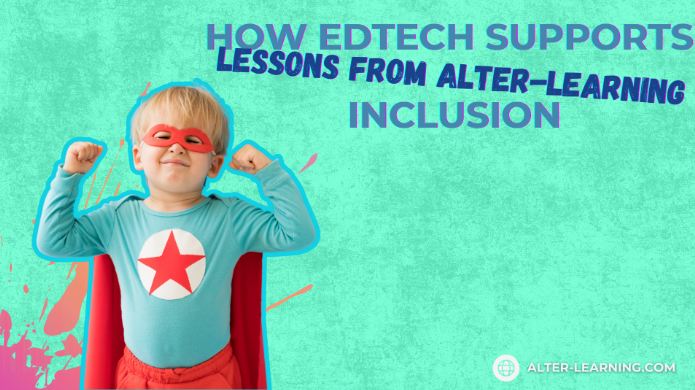
Inclusion is more than a buzzword—it is a commitment to ensuring every student, regardless of background, ability, or circumstance, has the opportunity to learn, grow, and thrive. Traditional classrooms often face barriers that prevent true inclusivity, whether through rigid teaching styles, inaccessible materials, or lack of support for diverse learning needs.
Educational technology (EdTech) can help address these challenges. Through immersive learning environments, STEAM educational games, and carefully designed accessibility features, platforms like Alter-Learning suggest how digital tools can create classrooms where all students feel welcome and capable of succeeding.
Inclusion as a Guiding Principle
Inclusion in EdTech isn’t just about meeting technical standards—it can be about recognizing the different ways students learn and ensuring tools are designed to support them. For learners with unique needs, this might include:
- Adaptive difficulty levels that adjust to each student’s pace,
- Audio cues and narration for students with reading or visual challenges,
- Colorblind-friendly design and customizable interfaces,
- Multiplayer modes that encourage collaboration, so no one learns in isolation.
These features help ensure that technology does not exclude learners but instead opens new doors for participation.
Supporting Different Learning Styles
Students approach education with varied strengths. Some are visual learners, others auditory or kinesthetic. Educational games can provide flexible pathways by:
- Incorporating 360-degree educational videos to add visual context,
- Embedding interactive physics simulations for hands-on experimentation,
- Offering digital art creation tools for creative expression,
- Using dialogue-based storylines to strengthen literacy and comprehension.
By blending these approaches, games can support multiple learning styles at once, helping each student engage in a way that feels natural.
The Role of Accessibility in Student Well-Being
Inclusion also extends to mental and emotional health. Alter-Learning’s Wellness Center, for example, shows how EdTech can provide supportive spaces where children build confidence, practice social-emotional skills, and feel empowered. Through tools like guided activities, cooperative play, and reflection prompts, students can grow not only academically but also personally.
Accessibility in this context means ensuring that every learner feels capable of participation, reducing anxiety and fostering resilience.
Inclusive EdTech does not only live in the classroom—it can also connect families to learning. With dashboards, progress reports, and collaborative features, parents and guardians can:
- Track student progress in real time,
- Reinforce lessons at home with shared activities,
- Engage in conversations about both achievements and challenges.
This connection strengthens support networks, making inclusion a shared responsibility between schools and families.
Through its design philosophy, Alter-Learning shows that inclusion is not a single feature but an ongoing process. By collaborating with educators, researchers, and developers, the platform emphasizes:
- Curriculum alignment, ensuring games match learning goals,
- Continuous evaluation, using feedback to refine accessibility features,
- Iterative design, where accessibility is improved over time,
- Collaborative learning environments, where students support one another.
These lessons highlight that inclusivity is never “finished”—it evolves alongside learners and technology.
Inclusion as the Future of Learning
Educational games and immersive technology can help reimagine classrooms as places where no student is left behind. By focusing on accessibility, adaptability, and emotional support, EdTech platforms can provide equitable opportunities for growth.
Alter-Learning’s emphasis on inclusive design demonstrates how technology can go beyond delivering content to shaping a culture of belonging. With STEAM educational games, VR education apps, and XR educational content, inclusion becomes not just possible—but central to how students learn.
Because when all students feel included, education doesn’t just inform—it empowers.
Follow Alter-Learning for more insights into immersive education, edtech success stories, and the future of learning. Want to explore how VR/AR could transform your school or learning platform? Let’s connect.